Published · Updated
Choose a sensible outdoor planting window before deciding when to sow indoors. Starting every packet on the same weekend can leave you with plants at very different stages when the garden is ready.
Choose the crop and planting method
Check the seed packet for whether indoor starting is recommended, how long seedlings should grow before transplanting, and any special germination requirements. Separate instructions for sowing seed from instructions for setting out a plant.
Count backward on paper
For a planning example, suppose you choose May 20 as a tentative transplant date and your particular packet recommends six weeks indoors. Counting back six weeks gives April 8. Those dates are an arithmetic example, not a planting recommendation for any city or crop.
Write the packet’s interval beside the date so you know where the estimate came from. Recheck your schedule if the weather delays transplanting. An earlier indoor start does not automatically create a better plant.
Allow for the transition outdoors
University of Minnesota Extension describes gradually acclimating indoor-grown seedlings to sunlight, wind, and outdoor temperature changes. Its guide outlines a transition of about two weeks. Plan this period before the intended planting day, while protecting seedlings from unsuitable weather. Do not automatically add it twice if your original instructions already include it.
Use a small tracking sheet
For each variety, record the packet instructions, tentative sowing date, emergence, planned transplant date, and actual transplant date. Leave room for notes about light, available indoor space, and whether a delay is manageable. This makes next season’s plan more useful than a copied calendar.
Before planting
Check current conditions and your crop’s requirements again. Read why soil temperature matters before deciding that a date alone means your garden is ready.
Gather supplies before you sow
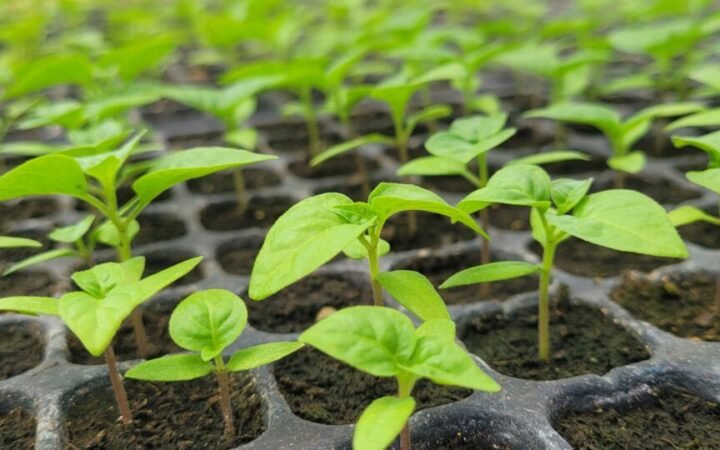
You need containers with drainage holes, a tray to catch water, labels, and a seed-starting mix. Use a mix made for seedlings. Garden soil tends to compact in containers and can carry pests and disease. Wash reused containers before filling them.
Give seedlings enough light
A sunny window is often not enough. Seedlings that grow tall, pale and floppy are usually reaching for light. Many growers use a fluorescent or LED grow light a few inches above the seedlings, raising it as they grow, and leave it on for roughly 14 to 16 hours a day with a period of darkness each night. Follow the instructions that come with your light.
Temperature, water and air
- Warm-season crops such as peppers germinate better in warmth. A heat mat under the tray is optional but helpful in a cool room.
- Keep the mix evenly moist, not soggy. Watering from the bottom helps avoid disturbing small seeds.
- Once seedlings emerge, remove any humidity dome so air can move.
- A small fan on low, or brushing your hand gently across the tops, helps build sturdier stems.
Thin and pot up
If several seeds sprout in one cell, keep the strongest and snip the others at the soil line. When roots fill the container and true leaves appear, move the seedling to a larger pot. Hold seedlings by their leaves, not their stems.
Example schedule with intervals
These intervals are commonly used ranges. Your seed packet wins if it says something different, and the dates below are arithmetic examples, not advice for a particular town.
- Tomatoes: roughly 6 to 8 weeks before transplanting. With a May 20 transplant date, that is April 8 to March 25.
- Peppers: around 8 weeks before transplanting. With a May 20 transplant date, that is March 25.
- Broccoli and other brassicas: roughly 4 to 6 weeks before transplanting. With an April 15 transplant date, that is March 18 to March 4.
Common mistakes
- Starting too early, which leaves leggy plants waiting for the weather.
- Too little light.
- Overwatering, which encourages seedlings to rot.
- Skipping hardening off before moving plants outdoors.
- Forgetting labels, so varieties get mixed up.
Tools and related guides
Use the seed-starting and hardening calculator to count back from your own dates, and read when to start seeds indoors for crop-by-crop timing.