Published
Start most vegetable seeds indoors 4 to 10 weeks before your average last spring frost date. Cabbage-family crops and lettuce sit at the short end, tomatoes take 6 to 8 weeks, and peppers and eggplant take 8 or more. Find your frost date, subtract the weeks for each crop, and sow on that day.
That one sentence is the whole method. The rest of this guide covers the parts that trip people up: which frost date to use, why published schedules disagree with each other, and what seedlings need once they are up.
The short version: weeks before last frost, by crop
A seed-starting date is your last frost date minus the crop’s lead time in weeks. The Old Farmer’s Almanac publishes a chart of those lead times, and Johnny’s Selected Seeds agrees on several crops (peppers at 8 weeks, cucumbers and squash at 3 to 4, lettuce at 4 to 5, celery at 10 to 12, leeks and onions at 8 to 10).
| Crop | Start indoors (weeks before last frost) |
|---|---|
| Broccoli, cabbage, cauliflower, Brussels sprouts, collards | 4 to 6 |
| Lettuce | 4 to 5 |
| Cucumbers | 3 to 4 |
| Tomatoes | 6 to 8 |
| Peppers | 8 |
| Eggplant | 8 to 10 |
| Leeks | 8 to 10 |
| Celery | 10 to 12 |
Source: The Old Farmer’s Almanac, “Starting Seeds Indoors.” Crops such as beans, carrots, corn and peas are not on the chart because they go straight into the ground.
Step 1: Find your last frost date
Your last frost date is the point in spring after which a freeze becomes unlikely. NOAA’s Climate.gov defines the last freeze as the date after which temperatures stay above 32°F for the rest of the season, and its map marks the day when the chance of a freeze drops below 50 percent. Because weather varies, the real date is known only after it has passed.
Those dates come from the 1991–2020 U.S. Climate Normals, a set of 30-year averages from NOAA’s National Centers for Environmental Information, and they are tied to weather stations rather than to your yard. You can look yours up with the Garden Clock frost date lookup, which uses the same NOAA normals for the station nearest your town.
Which frost date should you count from?
Most lookups give you the 50 percent date, meaning that in about half of past years frost came later. That is a coin flip for a tomato seedling.
NC State Extension explains the three levels in its publication on freeze and frost probabilities. The 10 percent level means the event happens in roughly 1 year out of 10, and the 90 percent level means roughly 9 years out of 10. For spring frost, the 10 percent date is the latest of the three and the cautious pick. The 90 percent date is the earliest and the gambler’s pick. The 50 percent date sits in the middle.
NC State’s worked example for Raleigh, North Carolina, shows how wide the gap is: spring frost on or after March 28 at 90 percent, April 12 at 50 percent, and April 26 at 10 percent. (That table uses older 1981–2010 normals and a 36°F frost threshold, so read it as an example of the spread, not as Raleigh’s current dates.) Two weeks separate the cautious date from the bold one, and every seed-starting date shifts by the same two weeks with it.
Following NC State’s risk framework, count from the 50 percent date for hardy crops such as cabbage-family plants and lettuce. For tender ones such as tomatoes, peppers and cucumbers, count from a later date: the 10 percent date if your tool shows one.
Step 2: Count back, with real dates
Take the frost date, subtract the weeks, and write the sowing date on the seed packet. Here are two worked examples. Each uses a published 50 percent date, with 2027 as the calendar year:
| Location and last frost | Tomatoes (6 to 8 weeks) | Peppers (8 weeks) | Broccoli (4 to 6 weeks) |
|---|---|---|---|
| Raleigh, NC, April 12 (NC State example) | Feb 15 to Mar 1 | Feb 15 | Mar 1 to Mar 15 |
| Boulder, CO, May 6 (NOAA Climate.gov) | Mar 11 to Mar 25 | Mar 11 | Mar 25 to Apr 8 |
If you use the Raleigh 10 percent date of April 26 instead, tomatoes move to March 1 through March 15 and peppers to March 1. Pick the date first, then do the arithmetic.
Why published schedules disagree
Search for this topic and you will find numbers that do not match. They are not wrong, they are measuring different things.
- Different starting lines. The Almanac counts weeks before the last frost. University of Minnesota Extension counts weeks indoors before transplanting, and lists tomatoes at 5 to 6 weeks, peppers, eggplant and okra at 9, and broccoli, cabbage and head lettuce at 10 to 11.
- Calendar months instead of weeks. Nebraska Extension’s Lancaster County office lists early March for cabbage, broccoli and cauliflower, mid-March for peppers and eggplant, late March for tomatoes and late April for melons, squash and cucumbers. Those months were written for Nebraska, and the page gives no frost date to convert them for anywhere else.
- Different frost dates underneath. A schedule built on a 10 percent date and one built on a 50 percent date can differ by two weeks, as the Raleigh example above shows, before anyone does any counting.
The fix is to pick one source for lead times, pick one frost date, and stick to both. If you only copy a month from somebody’s blog in a different climate, you are borrowing their frost date.
What indoor seedlings need once they are up
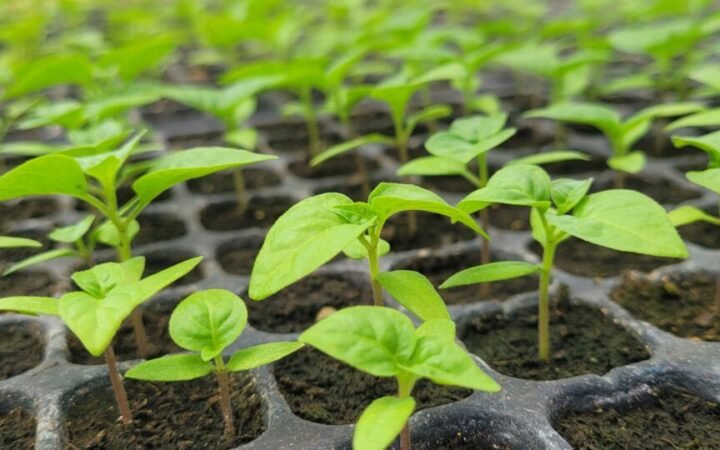
Timing gets seeds into the tray. These conditions keep them alive until transplant day.
- Light. University of Minnesota Extension says plants need 12 to 16 hours of light daily, with lights no more than 4 inches above the seedlings and 2 inches ideal. Nebraska Extension gives 4 to 6 inches as the upper limit. Raise the fixture as the plants grow.
- Warmth. Minnesota recommends keeping air above 60°F, and notes that potting mix can run as much as 5°F cooler than the air. Nebraska Extension puts 70 to 75°F as adequate for most flowers and vegetables, and says most flower seeds germinate best at 75°F.
- Feeding. Seedlings do not need fertilizer until they have several sets of true leaves. Both extension services suggest quarter-strength fertilizer once a week.
- Room to grow. Nebraska Extension suggests moving seedlings from flats to individual containers when the second pair of true leaves appears. Minnesota advises a container 1 to 2 inches wider for plants that outgrow their cell packs.
The Almanac adds one more point worth remembering: seeds sprout according to soil temperature, not the calendar. In a cold spring, delay sowing rather than forcing it.
Hardening off and transplanting
Seedlings raised under lights need to meet wind and direct sun before they go in the ground. University of Minnesota Extension recommends moving seedlings outside two weeks before planting, and Nebraska Extension describes setting them out on mild days for gradually longer periods, checking them often on breezy days because they dry out fast.
Transplant after the danger of frost has passed, and on a cloudy day or in the evening if you can.
That is where your frost date earns its keep a second time. Garden Clock’s planting calendar is built around three windows from the same data: start seeds indoors, transplant outdoors, and sow in fall.
How to use your own numbers
- Look up your nearest-station dates with the lookup tool.
- Choose your risk level: the 50 percent date for hardy crops, a later date for tender ones.
- Pick lead times from one source, such as the Almanac chart above.
- Subtract, write the dates on a calendar, and add the hardening-off period before your transplant date.
- Adjust for your yard. Frost dates describe a weather station, and low spots, hills, water and pavement shift the real date. Garden Clock’s disclaimer lists distance from the station, elevation, slope, buildings and cold-air pooling in low spots as the usual causes, and your county extension office knows your local quirks.
If a date looks wrong for your area, the contact page is the place to report it. Garden Clock’s About page explains where the data comes from, and the editorial policy describes how the site names its sources and states uncertainty.
Frequently asked questions
How many weeks before last frost should I start tomato seeds?
Six to eight weeks before your last frost date, according to the Old Farmer’s Almanac. University of Minnesota Extension counts differently and lists tomatoes at 5 to 6 weeks indoors before transplanting. Either way, pick one source and count back from the same frost date every time.
Can I start seeds too early?
Yes. Seedlings that outgrow their cell packs need larger containers, and Minnesota Extension suggests ones 1 to 2 inches wider. The Almanac also advises delaying sowing in a cold spring, because seeds sprout on soil temperature rather than the calendar.
What if I do not know my last frost date?
Enter your town in a frost date lookup. The number is the average date from the nearest NOAA weather station, so check it against your county extension office if your yard is on a hill, near water or in a hollow.
Should I use the 50 percent or 10 percent frost date?
Use the 50 percent date for hardy crops such as cabbage-family plants and lettuce. For tender crops, use a later date. NC State Extension describes the 10 percent date as the low-risk, conservative choice, because frost came after that date in only about 1 year in 10.
How much light do seedlings need?
Twelve to sixteen hours a day, with lights 2 to 4 inches above the plants per University of Minnesota Extension. Nebraska Extension allows up to 4 to 6 inches.
Which seeds should I not start indoors?
The Almanac’s chart leaves out beans, carrots, corn and peas, which are sown directly outdoors.
How long should I harden off seedlings?
University of Minnesota Extension says to start two weeks before planting outdoors. Nebraska Extension says several days of gradually longer outdoor time on mild days. Pick the window that matches how sheltered your seedlings have been.
Sources
- NOAA Climate.gov, Interactive map: average date of last spring freeze across the United States
- NC State Extension, Interpreting Freeze/Frost Probabilities from the National Centers for Environmental Information (AG-873)
- University of Minnesota Extension, Starting seeds indoors
- Nebraska Extension in Lancaster County, Starting Seeds Indoors